Fashion Fetishes: The Iconic Pieces That Define Style Forever

Updated: Jul 27
By Monica Trappolini — Your Personal Stylist Roma

Every so often, fashion produces something that transcends the season it was born in. A garment or accessory that ceases to be a trend and becomes something else entirely — a symbol, a reference point, a piece of cultural shorthand that every person who cares about clothes understands immediately.
These are what I think of as fashion’s true icons. Not the pieces that dominate a runway for one season and disappear. The ones that endure — that are as relevant, as covetable, as quietly powerful today as they were when they first appeared.
After more than thirty years in this industry — working across cinema, theatre, television, and personal styling — I have developed a deep affection for these pieces. They are the foundation of every great wardrobe I have ever built, and the reference points I return to again and again when working with clients. Understanding them is, I believe, one of the most important things anyone serious about style can do.
Fashion Fetishes: The Iconic Pieces That Define Style Forever
The Little Black Dress
No list of fashion icons begins anywhere other than here.
Gabrielle Chanel introduced the little black dress in 1926 — a simple, unadorned sheath that Vogue described at the time as the fashion equivalent of the Ford motor car: available to everyone, and destined to be worn by the whole world. She was right, but she could not have anticipated quite how enduring that prediction would prove.
Nearly a century later, the little black dress remains the single most versatile, most reliable, most consistently elegant garment in existence. It is the piece that works at a funeral and a gala, at a business dinner and a first date, in a Roman trattoria and a Mayfair hotel bar.
What makes it iconic is not its simplicity, but its intelligence. The little black dress is not a garment — it is a canvas. Everything else you wear with it, every accessory and shoe and piece of jewellery, becomes more visible, more considered, more powerful. It is, in the truest sense, the foundation upon which style is built.
In my work with clients, I consider a beautifully cut black dress — in a fabric of genuine quality, in a silhouette that serves the specific body wearing it — an absolute non-negotiable. It is the one piece I would always advise investing in without hesitation.
The Trench Coat
Thomas Burberry invented the trench coat for British officers in the First World War. What he could not have known is that he was simultaneously inventing one of the most enduring silhouettes in fashion history.
The trench coat is a paradox: it is military in origin and romantic in effect. Practical in function and deeply glamorous in association. It belongs to Humphrey Bogart in Casablanca and Audrey Hepburn on a Paris street, to Anna Wintour arriving at a show and to the woman at the corner café who simply knows how to dress.
What gives the trench coat its staying power is its extraordinary adaptability. Over a tailored suit, it is authoritative. Over a silk dress, it is effortless. Belted tightly, it defines a silhouette. Draped loosely over the shoulders — the Italian way, the way I always wear mine in Rome — it becomes something approaching art.
A great trench coat, in a fine gabardine or cotton, in the classic camel or a deep tobacco, is one of the most enduring investments in a wardrobe. It does not go out of fashion because it was never entirely in it.
The White Shirt
If the little black dress is fashion’s most elegant answer, the white shirt is its most intelligent question.
Borrowed from menswear, reinvented by women, elevated by designers from Yves Saint Laurent to Giorgio Armani to the ateliers of Jermyn Street — the white shirt is the great democratic icon of style. It belongs to every context, every decade, every body, every budget.
And yet it is deceptively demanding. A great white shirt — in a fine cotton or silk, cut with genuine precision, with collar and cuffs that hold their shape — is immediately distinguishable from a mediocre one. The difference is not always visible at first glance, but it is always felt. In the way it moves. In the way it sits. In the way it makes the person wearing it appear.
In my client work, I pay close attention to shirts. They are the piece most often underestimated and most consistently revelatory when upgraded. One extraordinary white shirt, chosen with care and worn with intention, can elevate an entire wardrobe.
The Silk Scarf
Italy and France have argued for centuries about who owns the silk scarf. I will not settle that debate here. What I will say is that, in thirty-four years of working in fashion, I have never encountered an accessory of greater versatility or more consistent power.
Tied at the neck in the classic manner, the silk scarf adds colour, pattern, and a kind of studied nonchalance that is very difficult to achieve by other means. Knotted on a bag, it transforms the mundane into the memorable. Wrapped loosely over the shoulders, it functions as a garment in its own right. Threaded through the hair, folded into a pocket square, tied at the wrist — its possibilities are, in practice, almost unlimited.
The great silk scarves — those produced by the historic houses of Italy and France, in weights and patterns that have been refined over generations — are among the most enduring objects in fashion. They do not age. They do not go out of style. They become, over time, more beautiful and more personal, carrying the patina of a life well lived.
This is one of the pieces I seek out most eagerly for clients during private shopping experiences in Rome. The right scarf, found in the right atelier, is a discovery that lasts a lifetime.
The Tailored Blazer
The blazer arrived in women’s wardrobes as an act of quiet subversion — borrowed from the male wardrobe, stripped of its associations with authority and conformity, and transformed into something altogether more interesting: a garment that could be simultaneously powerful and feminine, structured and relaxed, formal and deeply personal.
Yves Saint Laurent understood this earlier than almost anyone. His Le Smoking — a tuxedo jacket designed for women in 1966 — remains one of the most radical and most copied garments in fashion history. Not because it was shocking, but because it was right. It gave women a silhouette that was both commanding and elegant, and the fashion world has been exploring its possibilities ever since.
A great blazer — in a fine wool or linen, cut with genuine attention to the shoulder and lapel, in a colour that belongs to the person wearing it — is among the most transformative pieces in a wardrobe. It can make a simple t-shirt and jeans look intentional. It can make a dress look authoritative. Worn as a coat, belted over nothing at all, it becomes a statement of effortless confidence.
It is, in short, one of the pieces I recommend most consistently and most enthusiastically — and one I spend considerable time helping clients find in exactly the right version for them.
The Leather Bag
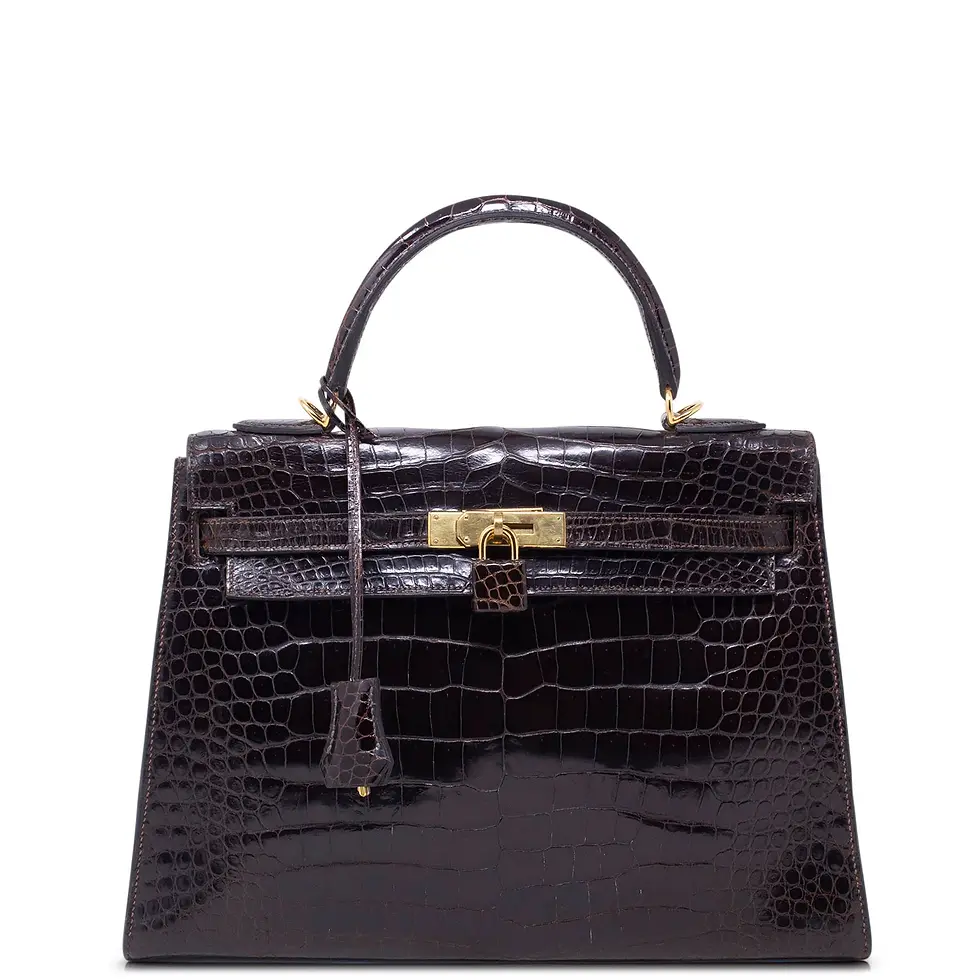
There are bags, and then there are bags — the ones that are designed not for a season but for a life. The ones that are constructed with such care, in leather of such quality, that they improve with age rather than deteriorating. The ones that become, over years of use, as personal and as recognisable as a signature.
The great leather bag icons — the Kelly, the Birkin, the Chanel 2.55, the Bottega Veneta Jodie — have achieved their status not through marketing but through merit. They are objects of genuine excellence: designed with intelligence, made with extraordinary craft, and conceived to endure.
In Rome, I have the privilege of knowing artisans who work at this level — whose bags will never appear in a department store, whose waiting lists are measured in months rather than days, and whose work represents some of the finest leather craft in the world. For clients who are serious about investing in a bag that will last a lifetime, these are the discoveries that make a private shopping experience in Rome genuinely extraordinary.
Building a Wardrobe Around Icons
The great fashion icons share a common quality: they are, at their finest, invisible. Not in the sense that they go unnoticed — quite the opposite. But they do not announce themselves. They do not demand attention. They simply make the person wearing them look more themselves: more considered, more confident, more present.
This is what I seek, always, when building a wardrobe with a client. Not the pieces that are most talked about, or most photographed, or most available. The pieces that belong — that fit seamlessly into a life and elevate every day of it.
If you would like to explore building a wardrobe around pieces of genuine, lasting quality — whether through a consultation, a private shopping experience in Rome, or both — I would be very glad to hear from you.
Monica Trappolini
Personal Stylist | Private Shopper | Costume Designer
Your Personal Stylist Roma — Rome, Italy
34 years of experience | Exclusively five-star reviews


Comments